Mostrando entradas con la etiqueta Stephens. Mostrar todas las entradas

lunes, 20 de abril de 2009

Lámina 25 de Catherwood

Hola, buenos días.
__Aquí va la última ilustración de Frederick Catherwood sobre sus viajes por el área maya. Estoy pensando iniciar próximamente otra serie con los dibujos de Tatiana Proskouriakoff. ¿Que os parece? Alguna otra preferencia o sugerencia? Buen comienzo de semana.
_

Lámina 25: Colosal cabeza en Izamal
_
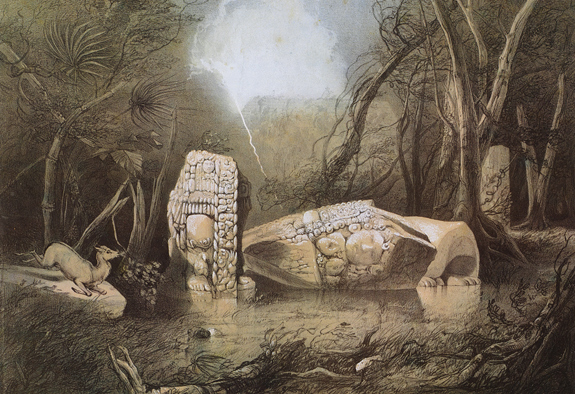
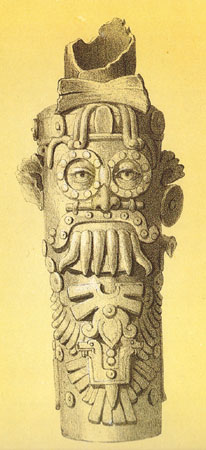
__"En esta imagen de la gran pirámide de Izamal, Kinich Kak Mo, la colosal cabeza de una figura Maya se vislumbra muy por encima del explorador naturalista, el Doctor Samuel Cabot Jr. La paleta de colores oscuros y misteriosos que utiliza Catherwood, en contraste con sus otros gravados a la luz del día, genera una imagen peristente. Catherwood representa cuidadosamente la imagen de la luna asomándose sobre la escena, mientras la colosal cabeza Maya observa con sus fauces abiertas a los intrusos cazadores de un jaguar, un animal que representaba a varias deidades mayas. Esta ilustración sumamente romántica de Catherwood es uno de los pocos registros que existen en Occidente de la cabeza colosal antes de que esta se desplomase.
__No es una coincidencia el que Catherwood haya dado tanta importancia a la luna y los jaguares en esta imagen. Las fases de la luna constituían la base del calendario Maya, y en Mesoamérica, el jaguar era uno de los animales más temidos y respetados, y representaba el poder y la autoridad. Por otra parte parece que Kinich Ahua, el dios sol, a quien esta pirámide fue dedicada, tenía cierta relación con el jaguar durante su recorrido nocturno hacia el abismo. Los mayas creían que cuatros bacabs (guardianes del cielo) sostenían las trece capas de la tierra, mientras que al jaguar se lo relacionaba a menudo con el abismo".

_
*__*__*__*__*__*__*
_
Plate 25: Colossal head, at Izamal (on stone, by H. Warren)
_
__"In this image of Izamal’s great pyramid, Kinich Kak Mo, the colossal head of a Maya figure looms high above the expedition’s naturalist, Dr. Samuel Cabot, Jr., and an unnamed Maya attendant. Catherwood’s palate of dark, mysterious colors, in contrast to his daylight prints, generates a lingering image. Catherwood carefully depicts the moon looking over the scene, as the colossal head of a Maya figure gapes at the intruders hunting a jaguar, an animal that represented several forms of ancient Maya gods. Catherwood’s highly romanticized illustration is one of the only Western records of the colossal head before it dropped to the ground.
__It may not be coincidental that Catherwood draws upon the importance of the moon and jaguars in this image. The moon’s phases formed one basis for the Maya calendar; and in Mesoamerica, the jaguar was one of the most feared yet respected animals, denoting power and authority. Moreover, Kinich Ahua, the sun god to whom this pyramid was dedicated, may have been linked to the jaguar when he made his nightly journey through the underworld. The Maya believed that four bacabs (sky-bearers) supported the thirteen layers of sky, but the jaguar was commonly associated with the underworld".
_
Mercedes Pepper (exhibition online Drawing from the Past)

martes, 31 de marzo de 2009

Lámina 24 de Catherwood

_
Lámina 24: Templo en Tulum
_
__"Tulum se encuentra en la costa, cerca de Cancún. Esta escena es una muestra del trabajo que tomaba despejar cada uno de los monumentos documentados en la expedición de Stephens y Catherwood. Esta litografía incluye el único retrato que se conoce de Catherwood, quien aparece hacia la derecha, midiendo el templo. La mirada del espectador es atraída hacia Catherwood y su ayudante, aun cuando los trabajadores indígenas aparecen en primer plano limpiando las ruinas.
__Catherwood cuenta que fue particularmente difícil despejar estas ruinas ya que estaban “tan cubiertas de árboles que fue por puro accidente que este y otros edificios fueron descubiertos.” Aunque fueron los trabajadores indígenas quienes hicieron la mayor parte del trabajo de limpieza, en su libro Incidents of Travel in central America, Chiapas, and Yucatán, Stephens escribe “hice a los indígenas a un lado y quité la tierra floja con mis propias manos.” Esta cita demuestra ese sentimiento de posesión que invadía a Stephens, así como su deseo de ser reconocido como el descubridor legítimo del monumento".

_
*__*__*__*__*__*__*
_
Plate 24: Temple at Tuloom
_
__"Tulum is located on the seacoast near Cancún. This scene depicts the labor required to uncover each monument chronicled in the expedition of Stephens and Catherwood. This lithograph includes the only known portrait of Catherwood, shown to the right measuring the temple. The viewer's eye is drawn to Catherwood and an assistant, despite the fact that the indigenous laborers are in the foreground clearing the ruin.
__Catherwood notes that Tulum was especially challenging to uncover because it was “so blocked up with trees, that it was by mere accident that this building and several others were discovered.” Although it was the indigenous laborers who did most of the intense clearing, in his Incidents of Travel in Central America, Chiapas, and Yucatán Stephens himself states that “I pushed the Indians away and cleared out the loose earth with my hands.” This quote demonstrates Stephens’ feeling of possessiveness and his desire to be credited as the true discoverer of the monument".

_
Megan Burbank y Claire Wilson

martes, 10 de marzo de 2009

Lámina 22 de Catherwood

_
Lámina 22: Teocalis en Chichén Itzá; El Castillo
_
__"Asomándose por un claro en plena selva de Yucatán, un monumental edificio Maya parece tocar el cielo, en la representación de Catherwood de la Pirámide de Kulkulcán. Aunque algunas partes de la estructura aparecen cubiertas por la densa vegetación, Catherwood quiso revelar el detalle más intrigante de la pirámide, dibujando en primer plano una de las muchas y elaboradas cabezas de serpiente.
__Esta pirámide Maya es una estructura de casi 80 pies de alto, de cuatro lados, con escaleras en cada uno. Hoy en día se pueden apreciar dos esculturas de cabezas de serpiente en la parte baja de cada escalera. Durante los equinoccios, en septiembre y marzo, el sol produce una sombra que se desliza por las 91 gradas de la escalera del norte, semejante a la figura de una serpiente desenrollándose. En la actualidad este sitio arqueológico sigue atrayendo a muchísimos turistas que fascinados admiran este magnífico tributo a Kulkulcán.
__Los mayas veneran una serpiente emplumada, el dios Kulkulcán o Quetzalcóatl. Cuenta la leyenda que un antiguo gobernador, Kulkulcán, fundó la ciudad Maya de Chichén Itzá, aunque hay varias versiones de esta historia. Una de ellas cuenta que el fundador errante fue consumido por fuego divino, y que su corazón se convirtió en el planeta Venus y sus cenizas en pájaros. En honor a esta deidad, los mayas edificaron las escaleras en forma de serpiente con asombrosa precisión. Catherwood logró identificar acertadamente el contexto religioso de la pirámide, por lo que la cabeza de serpiente de piedra aparece en primer plano."

_
*__*__*__*__*__*__*
_
Plate 22: Teocallis, at Chichén-Itzá (on stone, by A. Picken)
_
__"Rising through a clearing in the jungle of the Yucatán, a monumental Maya pyramid appears to touch the sky in Catherwood’s illustration of the Pyramid of Kulkulcán. Although parts of the structure are covered in dense foliage, Catherwood has unveiled the pyramid’s most intriguing detail by bringing one of its many elaborate stone snakeheads to the foreground.
__This Maya pyramid is a nearly 80-foot, four-sided structure with a staircase on each side. Today it is known that it has two snakehead sculptures at the bottom of each staircase. On the equinoxes in September and March the sun casts a shadow that cascades down the 91 steps of the northern staircase, resembling the shape of an uncoiling serpent. Today, the ancient site still draws many fascinated tourists who admire this skillful tribute to Kulkulcán.
__The Maya worshipped a feathered serpent god Kulkulcán, or Quetzalcóatl. Legend claims that an ancient ruler, Kulkulcán, founded the Maya city of Chichén Itzá. There are several versions of this story. In one, it was said that the wandering founder was devoured by divine fire. His heart turned into the planet Venus and his ashes became birds. To honor this deity, the Maya built the serpent staircases with astounding precision. Catherwood accurately identified the pyramid’s religious framework by dramatically bringing the stone snakehead to the illustration’s foreground".

_
Danielle Grogan and Shu Liu (Exhibition online Drawing from the Past)

martes, 20 de noviembre de 2007

Los dibujos de Catherwood - Lámina 12

Publicado el 28 de septiembre de 2006
_
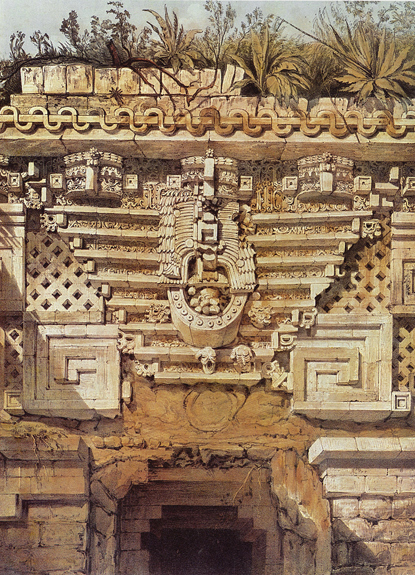
Ornamento Sobre la Puerta del Gran Teocalis, Uxmal
_
_"En el estudio de las civilizaciones antiguas, los mitos suelen evocar una sensación de misterio y motivar a la investigación más profunda de aspectos desconocidos de una cultura. Cuando John Stephens y Frederick Catherwood viajaron a Uxmal en 1840, los indígenas les contaron la leyenda de la Casa del Adivino.
__Según el relato de Stephens, una vieja mujer incubó de un huevo al hijo de un enano. El enano y el gobernador de Uxmal se desafiaron el uno al otro a realizar diversas hazañas para demostrar su fuerza. Una de ellas fue la de construir en una sola noche una casa que fuese más alta que todas las demás. Aunque el enano entró en desesperación a causa del reto, su madre le dijo que no se preocupase, y al día siguiente el enano se despertó en la que hoy en día se conoce como las casa del Enano (o del Adivino.). La leyenda de la Casa del Adivino, y el edificio mismo, capturaron la imaginación de los europeos, por lo que Catherwood representó el edificio en varias ocasiones. Stephens y Catherwood llamaron a la Casa del Adivino “el Gran Teocalis,” en referencia al teocalli, un templo prehispánico.
__Esta imagen muestra la fachada de la grandiosa estructura de la Casa del Adivino. La pared se distingue por su elegante obra de mampostería. Esta imagen pone en evidencia los efectos del paso del tiempo (desde la época en que los antiguos adoraban en el templo), ya que la fachada que antes estaba pintada yace ahora desnuda, y la sección central de la pared se ha derrumbado, revelando la entrada al templo interior. En primer plano se puede apreciar un ejemplo de las representaciones que hacía Catherwood de trabajadores indígenas en su tiempo de descanso, una escena que se repite en muchos otros grabados de esta colección".
_
______________________* * * * * * *
Ornament over the Gateway of the Great Teocallis
_
__"In the study of ancient civilizations, myths often evoke a sense of mystery and encourage further exploration into unknown aspects of a culture. When John Stephens and Frederick Catherwood journeyed to Uxmal in 1840, the indigenous people told them the legend of the House of the Dwarf.
__As related by Stephens, an old woman hatched a dwarf son from an egg. The dwarf and the ruler of Uxmal challenged each other to feats of strength, one of which was to build a house in one night that was higher than any other. Although the dwarf despaired at this challenge, his mother told him not to worry, and the next day the dwarf awoke in what is now called the House of the Dwarf. The legends of the House of the Dwarf, and the building itself, captured European imaginations, and Catherwood drew several scenes of the building. Stephens and Catherwood referred to the House of the Dwarf as the Great Teocallis, teocalli being a pre-Hispanic temple.
__This image depicts the façade of the superstructure of the House of the Dwarf. The wall is distinctive for its elegant stonework. The passage of time (since the ancients worshipped at the temple) is evident in this image, as the once-painted façade is now bare and the middle section of the wall has caved away, revealing an entrance to the inner temple. In the fore-ground is an example of Catherwood’s depiction of the indigenous workers reposing, a theme that extends to many other prints in this collection".
_
Anna NEWMAN (Exposición on line Drawing From the Past)

Los dibujos de Catherwood - Lámina 6

Publicado el 10 de agosto de 2006
_
Lámina 6: Vista general de Palenque / General view of Palenque
_
_
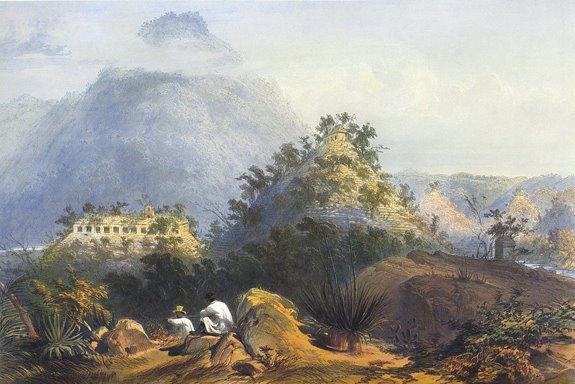
__"Esta imagen muestra el Templo de las Inscripciones (al centro) y el Palacio (a la izquierda), dos de las estructuras más reconocidas de Palenque, en la región de Chiapas, al sur de México. Los edificios aparecen detrás de un magnífico trasfondo de colinas arboladas y están cubiertos casi completamente por la vegetación. Catherwood dice que esta escena fue particularmente difícil de dibujar debido a la espesura del follaje que le impedía tener una visión clara y completa del lugar.
__Para Stephens y Catherwood la condición lamentable en que se encontraban las ruinas, reflejaba el detestable desinterés de los palencanos (del Siglo XIX) por la antigüedad. Los exploradores decidieron tomar cartas en el asunto adquiriendo derechos de propiedad sobre el lugar. Stephens se creía el dueño legal de las ruinas, y las veía como parte de la herencia cultural de los Estados Unidos, aduciendo que el sitio se encontraba dentro del continente “Americano”; al final, sin embargo, no logró adquirirlas. Catherwood, por otra parte, contrató a un conocido norteamericano para que fabricara moldes de yeso de los principales monumentos de Palenque. Pero su esfuerzo se vio truncado a causa de los reclamos de tres palencanos que consideraron que sus derechos ancestrales estaban siendo violados, demostrando así que en realidad no eran tan indiferentes como Stephens y Catherwood habían pensado".

* * * * * * *
__"This image depicts the Temple of Inscriptions (center) and the Palace (left), two of the most famous structures at Palenque in southern Mexico’s Chiapas region. The buildings are set off against a magnificent backdrop of wooded hills and have been almost completely reclaimed by the forest. Catherwood writes that this particular scene was especially difficult to draw due to the foliage which obstructed a clear view of the entire site.
__Stephens and Catherwood both felt the overgrown state of the ruins reflected a detestable disregard of antiquity on the part of the 19th-century Palencanos. The explorers decided to take action by gaining proprietary rights to the site. Stephens already believed himself a rightful owner of the ruins, viewing them as part of the cultural heritage of the United States due to their location on the “American” continent; in the end, however, he failed to actually purchase them. Meanwhile, Catherwood hired an American acquaintance to make plaster casts of Palenque’s primary monuments. However, this effort was halted by the protest of three Palencanos who felt their ancestral rights to the ruins were being violated, confirming that they were not as indifferent as Stephens and Catherwood had supposed".

_
Claire Wilson

Los dibujos de Catherwood - Lámina 2

Publicado el 26 de julio de 2006
_
Lámina 2: Edificio Piramidal y Fragmentos de Escultura en Copán /
Pyramidal Building and Fragments of Sculpture at Copán
_

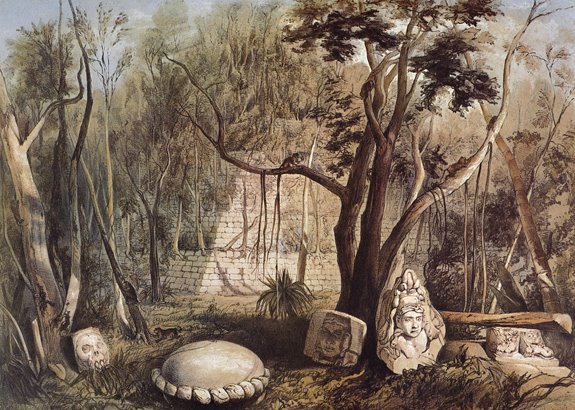
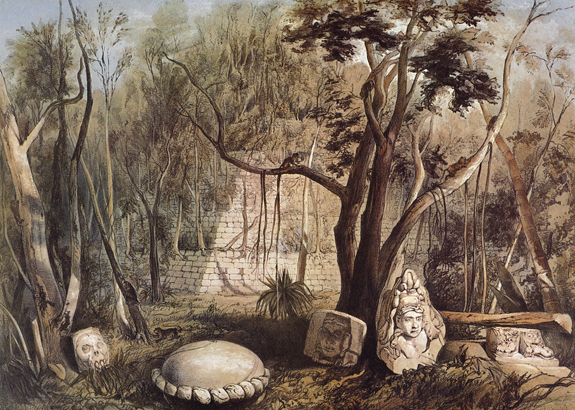
__"En la selva de Copán aún pueden encontrarse ruinas Maya olvidadas en el tiempo y sepultadas por la naturaleza. Stephens y Catherwood redescubrieron esta ciudad abandonada y registraron sus experiencias. Ya que el tiempo con el que Catherwood contaba para registrar estos nuevos descubrimientos era limitado, debía realizar varios bosquejos y acuarelas utilizando una cámera lúcida (similar a una lupa), que le ayudaba a reproducir los intrincados diseños que veía en las construcciones y esculturas Maya. Catherwood primero realizaba bosquejos de todo lo que veía y después los enviaba a Londres para que fuesen publicados en Incidents of Travel. Seis años más tarde, y tras el éxito de su libro, decidió crear una serie de veinticinco grabados de su expedición utilizando los bosquejos con que contaba y dibujando nuevos edificios de memoria. Este grabado, por ejemplo, muestra una serie de esculturas que se hallaron en un lugar cercano, pero que originalmente no fueron halladas frente a la pirámide, sino que aparecen como grabados individuales en Incidents of Travel.
__Catherwood junto a seis de los mejores litógrafos de Londres, utilizaron el grabado para sus publicaciones. La litografía, técnica relativamente nueva en esa época, les permitió realizar publicaciones extensas. La mayoría de los grabados se forman a partir del bosquejo de un artista plasmado directamente sobre un bloque de piedra caliza. La piedra es teñida con sepia luego de cada impresión. Después Catherwood pintaba a mano cincuenta colleciones con los colores que pueden apreciarse en cada grabado. Catherwood lanzó una publicación de 300 copias de cada grabado. Evidentemente su obra era bien conocida, lo cual le proveyó de los medios necesarios para terminar la serie completa".
_
* * * * * * *
_
__"In the jungles of Copán we still find ancient Maya ruins overcome by nature and long forgotten. Stephens and Catherwood rediscovered this abandoned city and documented their experiences. Since Catherwood worked under a time limit documenting these new discoveries, he did various sketches and watercolors using a camera lucida (similar to a magnifying glass), which helped him draw the intricate designs he saw on Maya buildings and sculpture. Catherwood first sketched everything, and then sent the sketches to London to be published for Incidents of Travel. Six years later, after the success of the book, he decided to make a set of twenty five prints from his expedition by reworking his previous sketches and drawing new compositions from memory. For instance this print shows a collection of sculpture found nearby, but not originally located in front of the pyramid (these individual sculptures can be found as etchings in Incidents of Travel).
__Catherwood, along with six of the best printers in London, used lithography to create his editions. Lithography, a relatively new technology at this time, allowed for the creation of large editions. Most lithographs are created by an artist drawing directly onto a block of limestone. The stone is inked in sepia after each impression. Catherwood then hand-painted fifty sets with the colors seen in each print. Catherwood printed an edition of 300 copies of each plate. This gives evidence that his work was very popular, providing him with enough financial support to complete his whole series"
_
Melianie Bove

Los dibujos de Catherwood - Lámina 1

Publicado el 26 de julio de 2006:
_
__Buceando por internet encontré una exhibición virtual de las láminas del dibujante y explorador Frederick Catherwood, en la que se describe cada una de las 20 obras.
__La exposición se titula Drawing From the Past: Maya Antiquity Through the Eyes of Frederick Catherwood (Aprendiendo del Pasado: La cultura Maya Antigua a través de los Ojos de Frederick Catherwood), la organizan estudiantes del Smith College (ya podíamos tomar ejemplo...) y se puede visitar en inglés y en español.
__Para darlos más a conocer, iré mostrándolos aquí junto con sus respectivos comentario en español e inglés.
Esta es la imagen de hoy:

_
_
_
_
Lámina 1: Ídolo en Copán / Plate 1: Idol at Copan
_
_
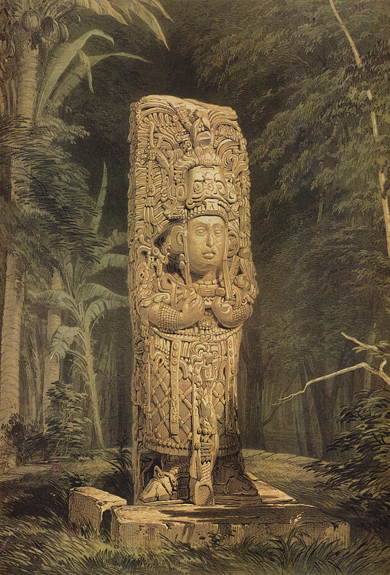
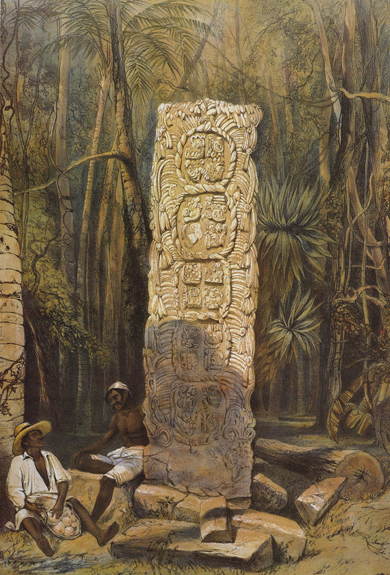
__"La espesa vegetación de Copán constituye el trasfondo de esta magnífica estatua de piedra erigida a inicios del Siglo VIII. La figura de la estela, con una altura de más de tres metros, lleva puesta una falda con diseño en forma de red, joyas en pedrería, un enorme tocado, y un bien ornamentado cinto con máscara colgantes, además de un cetro con dos protuberantes cabezas de serpiente.
__Cuando Stephens y Catherwood excavaron esta escultura, la vestimenta y la ausencia de barba, los llevó a pensar que se trataba de la imagen de una mujer. Aunque cabe resaltar que los hombres mayas solían usar túnicas largas en sus ceremonias religiosas, y hoy en día los expertos concuerdan que esta imagen representa a uno de los gobernantes más famoso de Copán, el Rey Waxaklajun Ub’aah K’awiil, vestido como uno de los dioses del maíz.
__Los sacrificios eran parte importante de la vida religiosa Maya ya que se creía que los dioses se habían sacrificado a sí mismos para crear el mundo. La iconografía de los dioses del maíz y las serpientes en esta estela tienen que ver con esta tradición. Cuatro dioses del maíz cuelgan a los lados de la figura, mientras que una mazorca y unas hojas de maíz aparecen justo encima del tocado. Por otra parte, las serpientes solían representar los sacrificios. En uno de los costados de la escultura dos serpientes se entrelazan y sostienen una figura grotesca y un instrumento que permitía a los mayas extraer su propia sangre para el sacrificio a los dioses. Para los mayas los sacrificios eran ritos sagrados de adoración a los dioses del maíz, y a otros dioses"
_
* * * * * * *
_
__"The overgrown jungle of Copán is the backdrop for a formidable stone statue erected in the early eighth century. Standing more than three meters high, the figure on the stele wears a net skirt, beaded jewelry, and a large headdress; masks hang from an ornate belt. He also holds a scepter with two protruding serpent heads. When Stephens and Catherwood excavated this sculpture, the dress and the absence of a beard led them to believe this was a woman. Yet Maya men did wear long tunics in religious ceremonies, and scholars now accept that this is one of Copán’s most famous rulers, King Waxaklajun Ub’aah K’awiil, in the guise of a maize god.
__Sacrifice was a significant part of Maya religious life because the gods sacrificed themselves to create the world. The iconography of the maize gods and serpents on this stele relates to this tradition. Four maize gods hang from the sides of the figure, and a maize cob and husks are depicted directly above the headdress. Serpents often represent sacrifice. On one side of the sculpture, two serpents intertwine and hold a grotesque figure and a blood-letter (an instrument that allowed one to draw one’s own blood for sacrifice to the gods). Performing sacrifice was sacred and vital to the Maya for honoring the maize gods, as well as others"
_
Morgan Middlebrook.